
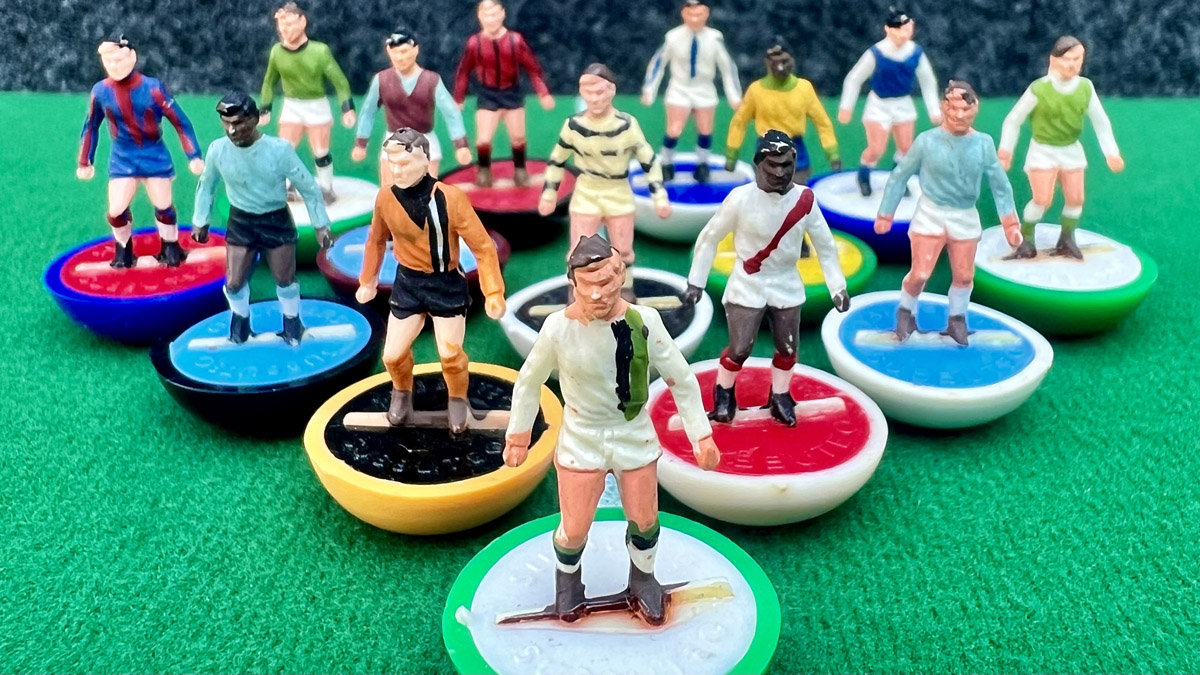
Collecting Subbuteo: A Journey Through the Heavyweight, Zombie, and Lightweight Eras (Up to 1996)
For many football fans, Subbuteo is more than a tabletop game—it’s a tactile slice of sporting history. Collecting Subbuteo has become a passion that blends nostalgia, craftsmanship, and the thrill of the hunt. From the charming imperfections of early heavyweights to the sleek uniformity of the lightweight era, Subbuteo’s evolution tells a story not just of a product line, but of changing tastes, manufacturing methods, and the enduring love for miniature football.
The Early Days: The Birth of the Heavyweight (1940s–1960s)
Subbuteo began in 1947, created by Peter Adolph, and the earliest figures—now known as “early heavyweights”—were a far cry from the detailed teams collectors cherish today. These first players were made of card, wire, and lead, hand‑assembled with a simplicity that now feels almost quaint. Yet they laid the foundation for what Subbuteo would become: a game where realism, collectability, and imagination met on a green baize pitch.
By the 1960s, Subbuteo had transitioned to plastic figures, and the heavyweight as we know it emerged. These early plastic heavyweights were cast in two halves, glued together, and hand‑painted. No two were ever exactly alike. A painter’s steady hand—or lack of it—could give a team character, charm, or occasionally a slightly wonky eye. For collectors today, these variations are part of the appeal. They represent a time when Subbuteo was as much a craft as a product.
The Classic Heavyweight Era (1967–1978)
Ask any seasoned collector which era defines Subbuteo’s soul, and many will point to the classic heavyweight period. Introduced in the late 1960s, these figures became the iconic Subbuteo look: chunky, balanced, and full of personality. They were durable, satisfying to flick, and beautifully hand‑painted in a dizzying array of kits.
This era coincided with Subbuteo’s explosion in popularity. The catalogue expanded rapidly, with clubs from across Europe and beyond represented in increasingly accurate colours. The heavyweight mould allowed for expressive poses—raised arms, angled torsos, and a sense of movement that made the game feel alive.
Collectors today prize heavyweights for several reasons:
- Hand‑painted individuality: No two teams are identical.
- Vibrant colours: Paint schemes were bold and often charmingly imperfect.
- Tactile feel: The weight and balance make them a joy to play with.
- Historical kits: Many represent designs long lost to time.
The heavyweight era is also where Subbuteo’s mystique grew. Rare teams—like certain South American sides or obscure European kits—became the stuff of legend. Tracking them down today is part detective work, part obsession.
The Zombie Era (1978–1980): A Misstep in Miniature
By the late 1970s, Subbuteo sought to modernise production. The result was the infamous “zombie” figure, introduced around 1978. Designed to be easier to assemble and more durable, zombies were moulded as a single piece with a separate base. In theory, this should have streamlined manufacturing. In practice, it created one of the most divisive chapters in Subbuteo history.
Zombies lacked the charm of heavyweights. Their faces were expressionless—hence the nickname—and their poses were stiff and lifeless. The painting quality dipped, and the figures felt less dynamic on the pitch. Collectors and players alike were unimpressed.
Yet today, zombies have found a niche appeal:
- They represent a transitional moment—a short‑lived experiment.
- Some teams are surprisingly rare, as production numbers were lower.
- Their oddity makes them memorable, even if not beloved.
The zombie era didn’t last long, but it remains a fascinating footnote—a reminder that even iconic brands can stumble.
The Lightweight Era (1980–1996): Streamlined, Standardised, and Mass‑Produced
In 1980, Subbuteo corrected course with the introduction of the lightweight figure. This design would define the brand for the next decade and a half. Lightweights were moulded in a single piece like zombies, but with a more natural pose, better proportions, and improved painting.
The lightweight era coincided with Subbuteo’s global peak. The 1980s and early 1990s saw the game become a staple of bedrooms, clubhouses, and school halls. The catalogue ballooned, with hundreds of teams, accessories, stadium components, and special editions.
Collectors appreciate lightweights for several reasons:
- Consistency: Figures were more uniform, making teams look cleaner.
- Playability: Their lighter build made them faster and more responsive.
- Huge variety: From Serie A to obscure African nations, the range was vast.
- Affordability: Many teams were produced in large numbers, making them accessible today.
This era also saw Subbuteo embrace the aesthetics of modern football. Kits became more detailed, sponsors appeared, and the game reflected the sport’s growing commercialisation.
The End of an Era: 1996 and the Pause in Production
By the mid‑1990s, Subbuteo faced new challenges. Video games were rising, manufacturing costs were increasing, and the brand struggled to reinvent itself. In 1996, production of the classic lightweight figures ceased, marking the end of what many collectors consider the “golden age.”
Later revivals would come—some successful, some less so—but the period from the early heavyweights to the final lightweights remains the heart of Subbuteo collecting.
Why Collecting Subbuteo Still Matters
For collectors, Subbuteo is more than plastic figures. It’s:
- A connection to childhood
- A record of football’s changing fashions
- A celebration of craftsmanship
- A community built on shared nostalgia
Each era offers something unique. Heavyweights bring artistry. Zombies bring curiosity. Lightweights bring breadth and playability. Together, they form a timeline of miniature football history.
The Thrill of the Hunt
Part of the joy of collecting is the chase—finding a rare heavyweight in a dusty box at a car boot sale, discovering a pristine lightweight team still in its cellophane, or finally completing a long‑sought catalogue number. Subbuteo collecting rewards patience, knowledge, and passion.
And as long as football inspires imagination, Subbuteo will continue to captivate collectors old and new.